
Generating leads is one of the biggest challenges businesses face in 2026. Not because of a lack of website visitors, but because of irrelevant website visitors. Companies need potential customers who are interested in their products and/or services, have a clear requirement, and are more likely to convert.
This is where a Google Ads management agency can make a difference. Companies can use different strategies for different campaigns, and use specific keywords, audience segments, etc. to optimize conversions and create effective, high-quality landing pages.
A well-managed Google Ads campaign can help businesses, big or small, reach potential customers who are searching for their services and/or products.
In this post, we will take a look at 7 ways you can use Google Ads to generate qualified leads in 2026.
What Is a Google Ads Management Agency?
A Google Ads management agency is a paid advertising agency, that with the available advertising budget, creates and executes a strategy to help its clients achieve their business objectives.
Normal services include:
- Setting up Google Ads accounts and campaigns
- Performing keyword research and analysis of search intent
- Managing campaigns on Search, Display, Shopping, and YouTube
- Writing ad copy and optimizing other campaign assets
- Setting up and managing conversion tracking
- Analyzing user behavior and landing page optimization
- Setting and adjusting budgets
- Optimizing bids
- Generating performance reports and analyzing campaign data
A good agency doesn’t just aim to increase click-through rates. It works to create campaigns and strategy to drive qualified traffic to facilitate interactions and sales.
One of the greatest advantages of using a PPC agency is that it creates campaigns to target users who are more likely to convert, have commercial intent, and are ready to buy.
The agency may perform additional keyword research to find terms aligned with the client’s offerings and sales goals. To do this, the agency may perform keyword research on the competition.
2. Target Competitor Keywords to Capture More Audience

Finding terms related to your client’s offerings is just one element of creating a successful keyword strategy. It’s also important to understand your client’s competitors and the keywords their audience is searching.
Let’s say there’s a legal services client that runs search campaigns with a keyword target of “divorce lawyer.” A potential competitor may use search terms like “family law attorney” or similar.
There are a few possible ways to capture audience for the competition.
- Create broad match modifiers for negative keywords. In this scenario, a broad match modifier negative keyword may include “courses.”
- Create a separate campaign with a broad match target for terms that align with the sales goal and audience, but exclude the competitor’s campaign term.
- Conduct keyword research on the competitors’ website to identify high-intent search terms that customers are using, and target those keywords.
- Separate Campaigns by Service
Businesses that offer multiple marketing services like SEO, PPC management and SMM should run separate campaigns/ads or tightly themed ad groups. - Regular Review of Search Terms
Use search term reports to find irrelevant queries and include new queries in your campaigns.
Using the example of a local dental clinic, rather than simply using broad informational queries like “types of dental implants,” they may want to include queries related to “book dentist appointment near me.”
This type of campaign helps eliminate wasteful spending and focuses ad spend toward the audience most likely to be interested in their service.
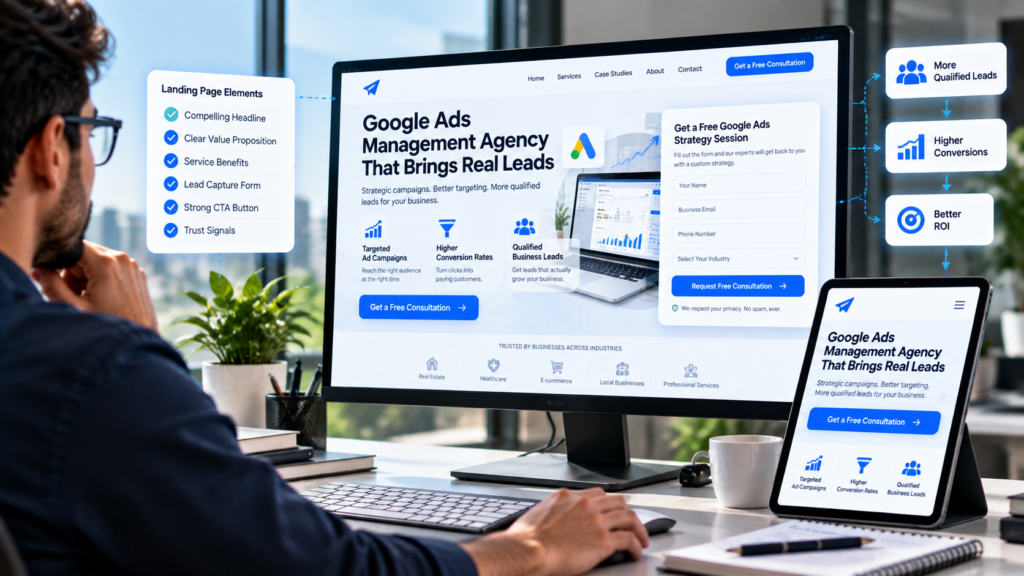
Match the landing page to the user’s search intent. Users who want the Google Ads management pricing should not have to go through unnecessary steps to locate pricing or be unable to locate pricing and have to request a quote.
An agency should test different elements such as headlines, calls-to-action, and page content to understand what influences users to fill out forms to the highest intent.
Bear in mind that having a low conversion rate isn’t always bad. A page can have a low conversion rate, but still be more valuable to the business because it generates leads that are more closely related to what the business sells.
track lead quality instead of lead quantity
Let’s look at a couple of campaigns with these results:
| Metric | Campaign A | Campaign B |
|---|---|---|
| Advertising spend | ₹10,000 | ₹10,000 |
| Total leads | 50 | 25 |
| Qualified leads | 5 | 15 |
| Cost per qualified lead | ₹2,000 | ₹667 |
Although Campaign A had a greater volume of leads, Campaign B had a greater quantity of leads for the same amount of budget spent.
This demonstrates the importance of looking at lead quality and conversion volume together.
A Google Ads management agency can connect advertising data with CRM data to see which campaigns are creating opportunities that move through the sales funnel and ultimately bring in customers.
4. Use Audience Targeting to Reach the Right Prospects
Knowing what your customers search can help you optimize for keywords, but knowing who your potential customers are can help with audience targeting.
2026 will bring the ability to integrate a number of things including audience targeting and geo-targeting along with search intent and first-party data, to improve advertising campaigns.
Audiences targeting strategies to consider
Geographic targeting: Zero in on a smaller section of an area you can legally serve, like focusing on one city or region instead of an entire country.
Remarketing: Reach previous web visitors who have shown interest in your business. Bring potential customers back with a remarketing campaign.
customers data: Use permitted first-party data to inform audience strategies.
Demographic insights: Review available demographic performance data to understand which audiences are responsive to your campaigns. Don’t make the assumption to exclude potential audiences without enough evidence.
Device performance: Look into which device user type (i.e. mobile, desktop, or tablet) generates better leads and strategize your ad campaign based on performance.
B2B companies should consider the buying journey when doing target audience analysis. A business owner doing research about a solution may require different information than a prospect who is ready to schedule a consultation, for example.
Finally, your audience analysis and targeting should work in conjunction with your keyword strategy. The ideal combination of the two should depend on your type of campaign, your historical conversions, the available data, and your business objectives.
Your advertisement influences who clicks on your website. If your message is too broad for example, you may end up attracting people who are not your customers at all.
Give enough information in your ad so that your customers understand what your business is about and what your business offers so that there are no false expectations.
Some best practices for Google Ads copywriting are:
- State the service you provide
- State the benefit of the service and/or how your service solves a problem
- Integrate messaging with your target keywords
- Give a clear call to action
- Incorporate relevant and available ads assets (i.e. sitelinks, structured snippets, callouts, and other ads extensions)
- Avoid misleading claims. Don’t guarantee results, clicks, or rankings.
For example, an agency managing Google Ads could test the following messaging:
Headline: Google Ads Management Services
Description: Our tailored management of your campaigns, coupled with conversions tracking and reporting, provides valuable insight for your business. Contact us for a consultation!
This Messaging shows the service provided without guaranteeing results.
You can test different messages and see how effective they are with the right metrics, qualified conversions, and cost per qualified lead.
The goal of advertising is to get your product or service in front of the right audience, and let them determine for themselves if they’re interested, or need your product or service.
6. Use Smart Bidding and Continuous Campaign Optimization
Google Ads offers automated bidding strategies that work to reach specific campaign goals. Automation does not remove the responsibility from the advertiser to adequately manage the campaign.
Your bidding strategy should align with your target goal.
Types of Automated Bidding Strategies
Maximize Conversions: Bids are managed to achieve as many conversions as possible within your campaign budget.
Target CPA: Bids are managed to achieve a specific average cost per acquisition (conversion).
Maximize Conversion Value: Bids are managed to achieve as much conversion value as possible within your campaign budget.
Target ROAS: Bids are managed to achieve a specific return on advertising spend (ROAS).
The best strategy changes depending on the type of campaign, how many conversions there are, the type of tracking, and the marketing budget.
What should be regularly reviewed?
A Google Ads management agency must regularly check:
- Search term relevance
- Keyword and audience performance
- The strength of ads and performance of assets
- Conversion rate of landing pages
- How the budget is allocated across campaigns
- Conversion tracking
- How much it costs to get a qualified lead
- Sales and revenue
For example, if one campaign results in multiple low quality inquiries and another attracts no inquiries at all, the budget could be moved to the stronger campaign.
However, these decisions should be based on enough data to make an informed decision. Reacting to short term changes can result in unnecessary changes that disrupt the system and ultimately harm performance.
Budgets can be set to only optimize for low quality form submissions and continue to find those types of leads.
Connecting your advertising platform with your CRM can not only help you visualize the customer acquisition process, but also provide insights into the other areas of your business.
Step 3: Take action. Based on what you know about your prospect, determine next steps and outline your plan of action.
For instance, based on the information captured from the lead, set your next appointment to demonstrate the product or service that best fits the customer need.
Step 3: Follow up promptly. Establish a process for contacting leads in your directory and scheduling consultations.
Step 4: Track sales progress. Record whether leads converted to opportunities and customers, or were lost.
Step 5: Feed quality data back into advertising. Where enabled and compliant with applicable policies, utilize enhanced conversions for leads or offline conversion imports to help measure the outcomes for the lead beyond the initial form submission.
Let’s consider a digital marketing agency that receives 100 leads per month. If the sales team is unable to identify the source of qualified leads, the agency may continue to invest in campaigns focused on volume as opposed to campaigns focused on return on investment (ROI).
Upon integrating the CRM, the agency can measure qualified leads, opportunities, and customer acquisitions by campaign and compare the customer acquisition cost (CAC).
For example, this enables a Google Ads management agency to strategically allot their advertising dollars.
How do potential agencies define qualified leads? How do they gauge their success beyond click or impression numbers?
A good partner outlines a strategy, gives estimates, and provides suggestions and adjustments based on concrete, measurable outcomes.
FAQ:
1. How can a Google Ads management agency create more qualified leads?
Through the combination of targeting high-intent keywords, optimizing audiences, creating relevant landing pages, and writing compelling ad copy, as well as tracking and measuring conversions, Google Ads management agencies can generate qualified leads. Prioritizing campaigns that achieve measurable outcomes (e.g. lead generation) in conjunction with advertisements can be helpful in identifying leads.
2. What is the average cost for Google Ads management in 2026?
Pricing for Google Ads management depends on the number of campaigns and advertisement budget. Some agencies charge a flat management fee, while others use a percentage of the ad spend or a combination of both. Businesses should review what is included in the pricing (e.g. landing page development, tracking, and reporting).
3. How long will it take to see leads from Google Ads?
Not all campaigns are the same. Some generate leads right away. Achieving consistency requires time and relies on a number of factors like competition, keyword demand, budget, the quality of the landing pages, and the offer. Once a steady stream of data is generated, optimizations can be made to further improve the campaign.
- The internal team managing and optimizing the PPC account should have a thorough understanding of the advertising platform. However, extensive experience is not required for the sales representatives making outbound calls.
- Understand your customers’ motivations, and your advertising campaigns will become stronger. More specifically, you should gain an understanding of what prompts your customers to take action. Once you understand your audience’s desires, writing ads becomes easier.
- It can be very beneficial to hire a marketing agency to assist with Google Ads because agencies specialize in a wide range of digital marketing channels. Furthermore, an agency brings in new ideas and more experience than an in-house employee.
- Determining the benchmark for leads isn’t very difficult. It is generally around the customer lifetime value, profit margin, or acquisition cost. Leads don’t have to be very cheap in order to make a good return on investment. In many cases, it is better to have leads at a slightly higher cost.
- The best type of keywords for generating leads with Google Ads is normally transactional or commercial keywords. These keywords indicate that the user has a stronger buying intent. Other search intent keywords to use are informational, navigational, and location based. With a strong negative keyword list, and a good understanding of your audience, you can achieve excellent lead generation with Google Ads.
These strategies can be implemented quickly to address lead quality issues.
- Use high-intent keywords.
- Improve landing page conversion.
- Track conversion.
- Reach target audience.
- Write ad copy to attract quality prospects.
- Optimize bidding and campaign performance.
- Connect ad data to CRM and sales process.
The overall goal is to spend money on lead generation to obtain leads with legitimate purchasing intent rather than aimlessly increasing website traffic or form fills.
A good Google Ads management agency can assist with training and support to increase team’s proficiency in analyzing and acting on campaign data.
A continuously evolving competitive landscape means an organization needs to be proactive in ensuring its advertising investment produces sustainable growth by regularly evaluating the quality of leads generated, cost per qualified lead, and sales outcomes.
Do your Google Ads campaigns produce low-quality leads? Prioritize changes to improve profitability and decrease unqualified leads to improve your return on ad spend (ROAS).
Leave a Reply