
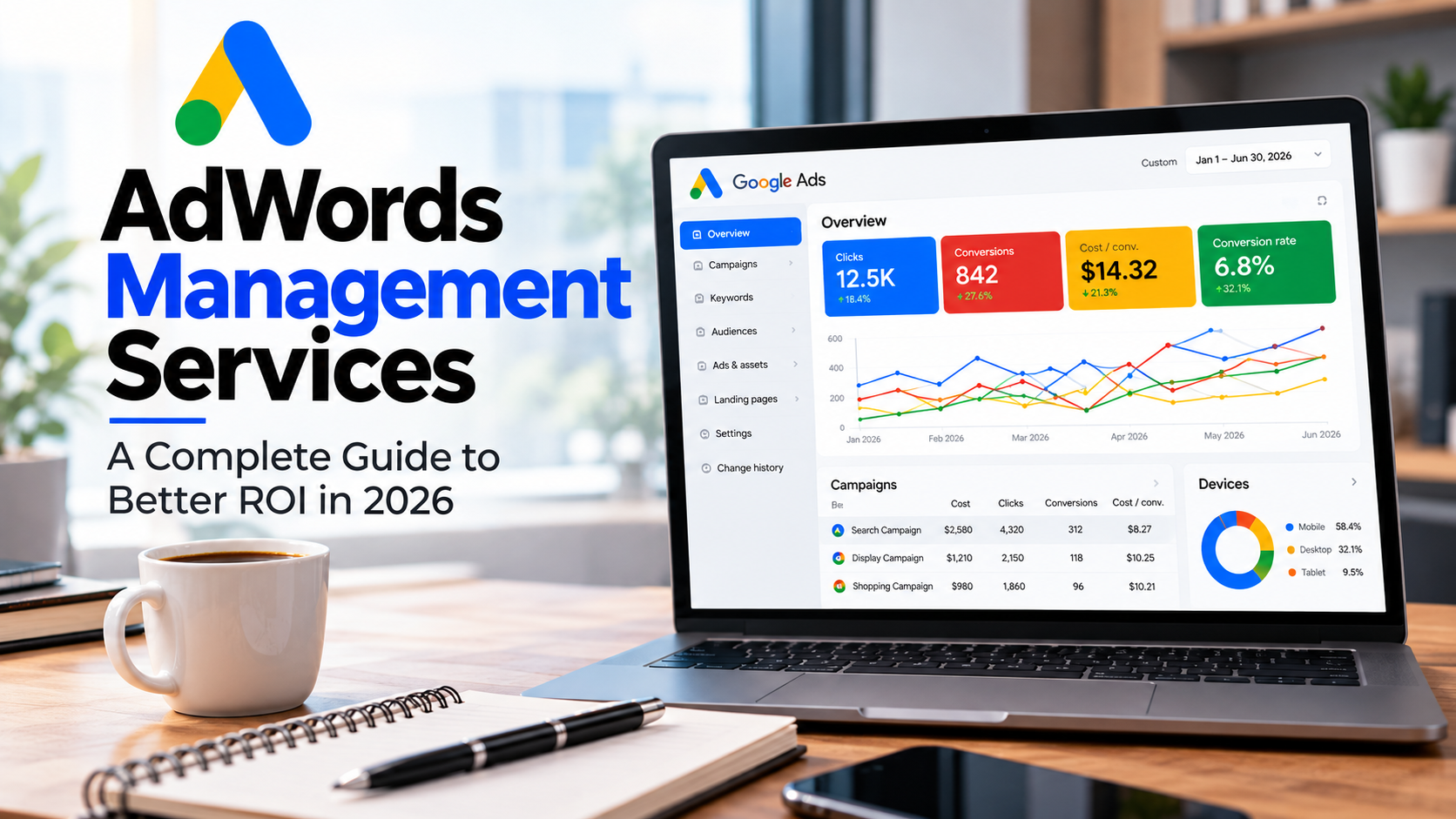
Running a business online is not just about getting visitors to your website. You also need to reach people who are genuinely interested in your products or services. AdWords management services help businesses create and manage Google Ads campaigns, target the right audience, and make better use of their advertising budget. With the right strategy, businesses can attract potential customers, generate more leads, and improve their return on investment.
Google Ads, formerly known as Google AdWords, allows businesses to display advertisements when potential customers search for relevant products or services. However, running profitable campaigns requires keyword research, audience targeting, compelling ad copy, conversion tracking, and continuous optimization.
Professional AdWords management services help businesses turn advertising budgets into measurable business outcomes. Whether you operate a local business, an e-commerce store, or a B2B company, the right campaign strategy can help you attract qualified prospects and improve return on investment (ROI).
In this guide, we will explore how Google Ads management works, which strategies matter most in 2026, and how to choose the right advertising partner.
Read More:- https://growaa.world/7-ways-a-google-ads-management-agency-can-generate-more-qualified-leads-in-2026/
What Are AdWords Management Services?
AdWords management services involve planning, creating, monitoring, and optimizing paid advertising campaigns through Google Ads. The primary objective is to connect businesses with potential customers who are actively searching for relevant solutions.
Instead of managing every campaign manually, businesses can work with experienced PPC specialists who use data, testing, and optimization techniques to improve campaign performance.
Typical services include:
- Google Ads account setup and campaign management
- Keyword research and search intent analysis
- Search advertising and display advertising
- Performance Max campaign management
- Ad copywriting and responsive search ads
- Audience targeting and location targeting
- Conversion tracking and analytics integration
- Landing page optimization recommendations
- Negative keyword management
- Budget allocation and bid optimization
- Performance reporting and ROI analysis
A well-managed advertising campaign focuses on business outcomes rather than impressions or clicks alone.
For example, a dental clinic may want appointment bookings, while a software company may prioritize qualified demo requests. The campaign structure, keywords, landing pages, and conversion goals should reflect these different objectives.
Why Businesses Need AdWords Management Services in 2026
Google Ads continues to provide businesses with opportunities to reach customers at different stages of the buying journey. However, competition, changing search behavior, and automated campaign features make strategic management increasingly important.
1. Reach High-Intent Customers
Search advertising allows businesses to reach users who are already looking for specific products or services.
For example, a person searching for “Google Ads agency for small business” may be closer to hiring an advertising partner than someone casually browsing digital marketing tips.
By targeting relevant commercial keywords, businesses can focus their budgets on users who demonstrate stronger purchase intent.
2. Control Advertising Costs
Every click costs money, and poorly structured campaigns can consume budgets without producing meaningful results.
Professional campaign management helps identify expensive, irrelevant, or underperforming search terms. Advertisers can then refine targeting, adjust bids, improve ad relevance, and allocate spending toward campaigns that generate better results.
However, lower cost per click does not automatically mean better performance. The goal is to acquire valuable customers at a sustainable cost.
3. Improve Lead Quality
Generating a large number of leads is not enough if those leads do not convert into customers.
Effective PPC campaign management considers the entire customer journey, from the search query to the landing page and final conversion.
For example, a home loan company can refine its keywords, service locations, ad messaging, and lead forms to attract people seeking relevant financing solutions rather than unrelated financial information.
4. Measure Campaign Performance
Google Ads can be connected with Google Analytics 4 and conversion tracking tools to measure actions such as purchases, form submissions, phone calls, and appointment bookings.
Accurate measurement helps businesses understand which campaigns contribute to their goals and where improvements are needed.
Key Components of Effective Google Ads Management
A successful advertising strategy involves several connected activities. Each component influences how efficiently a campaign attracts and converts potential customers.
1. Keyword Research and Search Intent
Keyword research is one of the foundations of effective AdWords management services.
Read More:- https://growaa.world/seo-services-marketing-a-complete-guide-to-growing-your-business-online-in-2026/
The process involves identifying search terms that align with your products, services, target audience, and advertising objectives.
Keywords generally fall into several categories:
- Transactional keywords: Buy, hire, book, or order-related searches.
- Commercial keywords: Best provider, agency comparison, pricing, or service evaluation.
- Informational keywords: Searches for guides, explanations, or educational content.
- Local keywords: Searches containing a city, neighborhood, or nearby-service intent.
For paid campaigns, commercial and transactional keywords often deserve special attention because they may indicate stronger buying intent.
Advertisers should also select appropriate keyword match types and review actual search terms regularly. Negative keywords help prevent ads from appearing for irrelevant searches.
2. Campaign Structure and Targeting
A clear account structure makes campaigns easier to manage and optimize.
Businesses can organize campaigns according to service categories, product lines, locations, or advertising objectives. Ad groups should contain closely related themes so that the advertisements and landing pages remain relevant.
Targeting decisions may include:
- Geographic location and service areas
- Language preferences
- Device performance
- Audience segments
- Customer acquisition versus remarketing
- Business hours and conversion patterns
For local businesses, location targeting is especially important. A company serving Jaipur, for example, may not want to spend its budget on customers located outside its service area.
3. Compelling Ad Copy
Your advertisement should communicate why customers should choose your business.
Effective ad copy connects the user’s search intent with a relevant benefit, a credible point of differentiation, and a clear call to action.
Consider these examples:
- Get a Free Consultation
- Compare Service Plans
- Book Your Appointment
- Request a Custom Quote
- Improve Your Campaign Performance
Responsive search ads allow advertisers to provide multiple headlines and descriptions that Google can test in different combinations.
Businesses should ensure that their claims are accurate, their messaging matches the landing page, and their calls to action reflect the actual offer.
4. Conversion Tracking and Analytics
Conversion tracking helps businesses measure whether their advertisements produce meaningful results.
Without reliable tracking, advertisers may optimize campaigns around clicks rather than actual business performance.
Common conversion actions include:
- Completed lead forms
- Qualified phone calls
- Online purchases
- Appointment bookings
- Demo requests
- Qualified sales opportunities
Google Ads conversion tracking, Google Analytics 4, Google Tag Manager, and website integrations can help measure these actions.
Before launching campaigns, verify that conversion events fire correctly and avoid counting the same action multiple times. For lead generation, connecting offline sales outcomes or qualified lead data can provide a more complete picture of campaign value.
5. Landing Page Optimization
Even a relevant advertisement can underperform when it sends visitors to a confusing or slow website.
Landing pages should directly address the user’s search intent and make the next step obvious.
Important elements include:
- A clear headline that matches the advertisement
- A concise explanation of the service or product
- Relevant benefits and supporting information
- Trust signals, testimonials, or case studies where appropriate
- A visible call to action
- Mobile-friendly design
- Fast loading times
- A simple, functional lead form
Landing page improvements can increase conversion rates without requiring a corresponding increase in advertising spend.
Advanced Strategies to Improve Google Ads ROI in 2026
Businesses seeking stronger results should move beyond basic campaign setup and use a structured optimization process.
1. Optimize Bidding Based on Business Goals
Google Ads offers automated bidding strategies such as Maximize Conversions, Target CPA, Maximize Conversion Value, and Target ROAS.
The appropriate strategy depends on campaign objectives, available conversion data, and business economics.
For example, a lead generation company may prioritize qualified inquiries and cost per acquisition, while an e-commerce business may focus on revenue and return on ad spend.
Automated bidding works best when conversion tracking is reliable and the selected goal accurately reflects business value.
2. Use AI-Powered Campaign Features Carefully
Google Ads uses automation and machine learning across several campaign types.
Performance Max can help advertisers reach customers across eligible Google inventory, while responsive search ads use combinations of supplied creative assets.
These features can expand reach, but automation still requires strategic inputs. Advertisers should provide relevant creative assets, accurate conversion signals, suitable landing pages, and clear business objectives.
Monitor results regularly instead of assuming that automated campaigns will always perform efficiently.
3. Analyze Search Terms and Exclude Irrelevant Traffic
Search term analysis reveals the queries that trigger search advertisements.
For instance, a company selling professional advertising services might want to exclude searches related to free courses, employment opportunities, or unrelated software tutorials.
Regularly reviewing search terms helps improve traffic relevance and protect advertising budgets.
4. Improve Quality Score Factors
Google’s Quality Score diagnostic considers expected click-through rate, ad relevance, and landing page experience.
Improving these factors can support stronger campaign performance, although Quality Score is not itself a direct business outcome or a complete measure of auction performance.
Keep keywords, advertisements, and landing pages closely aligned to improve the overall user experience.
5. Evaluate Results Beyond Clicks
A high click-through rate does not guarantee profitable advertising.
Businesses should monitor metrics such as:
| Metric | What It Measures |
|---|---|
| CTR | Percentage of impressions that generate clicks |
| CPC | Average cost per click |
| Conversion rate | Percentage of relevant interactions that result in conversions |
| CPA | Average cost per acquisition or conversion |
| ROAS | Revenue generated relative to advertising spend |
| Lead quality | How relevant and sales-ready generated leads are |
The right combination depends on the business model. For service businesses, qualified leads and closed sales may matter more than website traffic. For online stores, revenue, margins, and repeat purchases are also important.
How Much Do AdWords Management Services Cost?
The cost of AdWords management services depends on campaign complexity, advertising budget, number of locations, competition, and the level of support required.
Common pricing models include:
- Fixed monthly fee: A predetermined amount for ongoing campaign management.
- Percentage of ad spend: The management fee changes according to advertising expenditure.
- One-time setup fee: A separate charge for account configuration, conversion tracking, and campaign launch.
- Custom pricing: A tailored arrangement for larger accounts or complex advertising requirements.
Remember that the management fee and advertising budget are usually separate expenses.
For example, a business may pay an agency to manage its account while paying Google separately for advertising clicks. When comparing proposals, ask about setup charges, reporting, landing page support, conversion tracking, and optimization frequency.
The lowest fee is not always the best option. Evaluate the provider’s approach, transparency, communication, and ability to connect advertising performance with actual business results.
How to Choose the Right AdWords Management Agency
Selecting an advertising partner requires more than comparing prices.
Use these steps to evaluate potential providers:
- Review relevant experience: Look for experience with your industry, business model, or campaign objectives.
- Ask about strategy: A capable provider should explain keyword selection, campaign structure, targeting, and optimization.
- Verify conversion tracking: Ensure the agency can measure meaningful actions and explain how results are validated.
- Understand reporting: Request clear reporting on costs, conversions, qualified leads, and revenue where available.
- Confirm account ownership: Your business should retain appropriate access and ownership of its Google Ads account and data.
- Discuss communication: Establish reporting frequency, optimization priorities, and how important changes will be communicated.
- Evaluate realistic expectations: Be cautious of guaranteed rankings, guaranteed lead volumes, or promises of a specific ROI without supporting evidence.
A reliable partner should explain both opportunities and limitations. Advertising performance depends on competition, pricing, website quality, demand, and sales processes, so results cannot be guaranteed.
Common Google Ads Management Mistakes to Avoid
Even businesses with substantial advertising budgets can lose money when campaigns lack a clear strategy.
Avoid these common mistakes:
- Launching campaigns without proper conversion tracking
- Targeting overly broad or irrelevant keywords
- Ignoring negative keywords
- Sending every advertisement to the homepage
- Making frequent changes without allowing sufficient evaluation time
- Increasing budgets before confirming campaign efficiency
- Ignoring mobile user experience
- Focusing exclusively on clicks or impressions
- Failing to review lead quality and sales outcomes
A structured optimization process helps advertisers make decisions using evidence rather than assumptions.
Conclusion
Effective AdWords management services combine keyword research, campaign structure, compelling advertisements, accurate conversion tracking, and continuous optimization. Together, these activities help businesses reach relevant audiences, manage advertising costs, and improve the likelihood of generating profitable leads or sales.
In 2026, automation and AI-powered campaign features create new opportunities, but strong results still depend on sound strategy, reliable data, relevant landing pages, and regular performance evaluation.
Start by defining your business goals, measuring conversions correctly, and identifying the campaigns that generate the most valuable outcomes. Whether you manage campaigns in-house or work with a professional agency, focus on measurable business growth rather than clicks alone.
Frequently Asked Questions (FAQs)
1. What are AdWords management services?
AdWords management services involve setting up, monitoring, and optimizing Google Ads campaigns to help businesses attract relevant traffic, generate leads, increase sales, and manage advertising costs. They typically include keyword research, ad creation, bidding optimization, conversion tracking, and performance reporting.
2. Are Google Ads management services worth it for small businesses?
Yes, Google Ads management services can be valuable for small businesses that want to reach customers actively searching for their products or services. A focused campaign, suitable budget, accurate tracking, and relevant landing pages can help businesses evaluate whether paid advertising generates a sustainable return.
3. How much do AdWords management services cost?
Pricing varies according to advertising spend, campaign complexity, and the provider’s scope of work. Some agencies charge a fixed monthly management fee, while others use a percentage of ad spend or a combination of setup and ongoing fees. Advertising costs are generally separate from management fees.
4. How long does it take for Google Ads campaigns to generate results?
Some campaigns may generate clicks or leads shortly after launch, but reliable performance evaluation takes longer. The timeline depends on competition, search demand, budget, conversion tracking, website quality, and sales cycles. Campaigns should be evaluated using sufficient data rather than a fixed guarantee.
5. What is the difference between PPC management and AdWords management services?
PPC management refers to managing pay-per-click advertising more broadly, while AdWords management services traditionally refer to managing campaigns on Google Ads. PPC can also include advertising on other platforms. Both approaches can involve keyword research, bidding, ad copy, conversion tracking, and ROI optimization.
6. How can I improve ROI from Google Ads?
Improve ROI by targeting relevant keywords, excluding irrelevant search terms, testing ad copy, optimizing landing pages, tracking conversions accurately, and allocating budget toward valuable campaigns. Where possible, measure qualified leads and actual sales rather than relying exclusively on clicks or form submissions.
7. Which metrics should I track when using AdWords management services?
Important metrics include click-through rate, cost per click, conversion rate, cost per acquisition, lead quality, and return on ad spend. The most useful metrics depend on your objectives. Lead generation businesses should prioritize qualified leads and customer acquisition costs, while e-commerce businesses should also evaluate revenue and profitability.
8. Can AdWords management services help generate local leads?
Yes. Businesses can target relevant geographic areas, local search terms, and service-specific keywords. Combining accurate location targeting with clear advertisements, mobile-friendly landing pages, call tracking, and qualified lead measurement can help local businesses attract more relevant inquiries.
9. What should I look for in a Google Ads management agency?
Look for transparent reporting, relevant experience, accurate conversion tracking, clear communication, realistic expectations, and a documented optimization process. Confirm that you retain appropriate account access and understand how the agency measures performance.
10. Should I hire an agency or manage Google Ads myself?
Managing campaigns yourself may be suitable when you have the time and expertise to research keywords, configure tracking, and optimize performance. An agency may be helpful when campaigns become complex, advertising spend increases, or your business needs specialist support. Compare the total cost, available expertise, and expected business value before deciding.
Leave a Reply